
Breaking: Finally, EU Agrees To ‘Reset’ Its Relations With Northern Ireland
The European Union has agreed to reset its relations with Northern Ireland ‘to put the people first’ after it backed down from its decision to trigger Article 16 of the Northern Ireland Protocol, according to Michael Gove.
The Cabinet Office minister said the union had ‘recognised they made a mistake’ in pursuing Article 16 – which allows the EU and UK to choose to suspend any aspects they consider to be causing ‘economic, societal or environmental difficulties’.
The bloc faced condemnation for the action from London, Dublin and Belfast as it came amid a deepening dispute over delays to the production and distribution of the coronavirus vaccine across Europe.
Gove said: ‘I think the European Union recognises that they made a mistake in triggering Article 16 which would’ve meant the reimposition of a border on the island of Ireland. But now the European Union has stepped back.
‘I’ve spoken to the European Commission vice-president Maros Sefcovic about this and we both agreed that we need a reset, that we need to put the people of Northern Ireland first.’
It comes after Brussels backed down from plans to impose export controls on vaccines that threatened the shipment of 3.5million Pfizer doses to Britain.
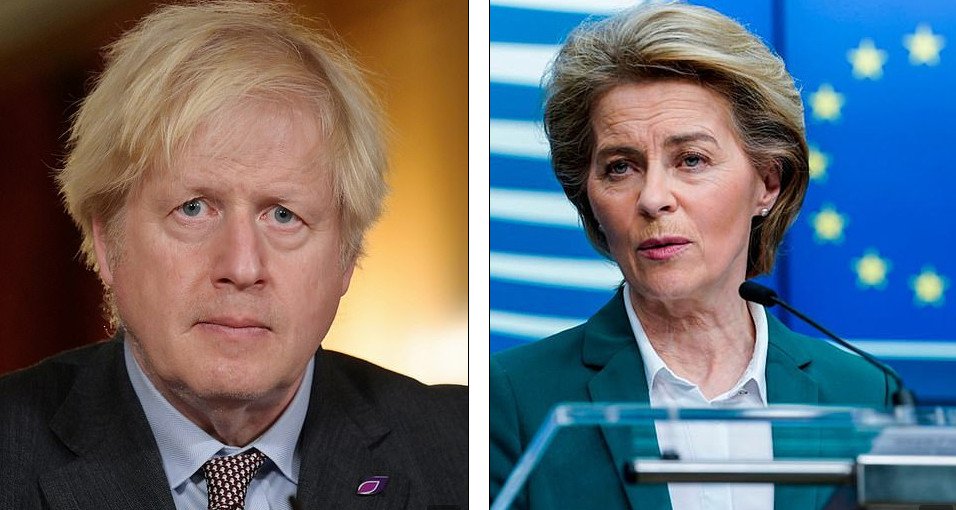
Commission President Ursula von der Leyen made the assurance to Boris Johnson after announcing an extraordinary embargo on jabs leaving the bloc amid dwindling supplies on the Continent.
As leaders were left reeling from the EU’s incendiary move:
- The UK recorded 1,200 more Covid deaths, 23,275 cases and vaccine doses administred rose to 8.4million;
- Vaccines expert Sir John Bell said Macron was ‘managing demand’ by claiming AstraZeneca jab is ‘almost ineffective’ on over-65s;
- Early data showed the UK’s vaccination drive is already easing UK’s Covid pandemic and is reducing cases as well as protecting recipients from symptoms;
- It was revealed Boris Johnson wants lockdown exercise rules relaxed but shops, gyms and hairdressers could stay shut until April and pubs might not open until May;
- The European Press put the boot into EU leaders over their ‘deplorable’ Covid vaccine bungling and attempt to introduce checks at Northern Ireland border;
- Boris Johnson sent an open letter to all Britain’s parents and promised a multi-million-pound catch-up programme once schools finally reopen.
The row blew up spectacularly when Eurocrats overrode part of the Brexit deal to create a hard border on the island of Ireland to stop doses getting into the UK through Northern Ireland, which is still in the Customs Union.
The move blindsided the governments of London, Dublin and Belfast whose collective outrage forced a humbling climbdown and clarification from the EU it did not intent to trigger the incendiary Article 16.
And the EU has now rowed back yet further and scrapped its export ban for the UK entirely following a phone call between Ms von der Leyen and the Prime Minister.
Gove said this afternoon the EU ‘recognises they made a mistake’ and ‘stepped back’ following the conversation between the two leaders.
He said: ‘We’re confident, we have assurances, that the supply that we have procured, the supply that we have paid for, is going to be delivered.’
Downing Street said it did not intend to dwell on the night of high drama but politicians in Britain are furious with the EU’s behaviour.
Former Northern Ireland Secretary Julian Smith said the attempt to halt the free flow of goods on vaccine exports on the island of Ireland with scant awareness of the sensitivities was an ‘almost Trumpian act’.
The Tory MP added: ‘The EU cocked up big time last night, but we all need to work in the interest of preserving Northern Ireland. It is not just a backdoor for goods going to Britain, it is a very sensitive place and we have a duty between the EU and UK to ensure there is no hard border.’
Stormont’s first minister Arlene Foster called the move an ‘incredible act of hostility’ and this morning said the rift emanated from the ‘EU’s vaccine embarrassment and mismanagement’.
While Britain has already inoculated 11 per cent of its population, the rollout on the Continent has been blighted by supply issues and the EU has demanded UK doses are instead diverted to the bloc.
French President Emmanuel Macron poured petrol on the rift yesterday when he baselessly claimed there was no evidence the Oxford-AstraZeneca shot worked in over-65s, despite it gaining approval from the EU regulator.
Michel Barnier, who was the EU’s chief Brexit negotiator in the trade deal struck only 29 days ago, today tried to cool tensions and appealed for ‘cooperation’.
Ms von der Leyen last night tweeted: ‘Constructive talks with Prime Minister Boris Johnson tonight.
‘We agreed on the principle that there should not be restrictions on the export of vaccines by companies where they are fulfilling contractual responsibilities.’
It came about an hour after a statement from the Commission outlining the detail of the export controls of vaccines.
It said: ‘To tackle the current lack of transparency of vaccine exports outside the EU, the Commission is putting in place a measure requiring that such exports are subject to authorisation by the Member States.
‘In the process of finalisation of this measure, the Commission will ensure that the Ireland / Northern Ireland Protocol is unaffected. The Commission is not triggering the safeguard clause.
‘Should transits of vaccines and active substances toward third countries be abused to circumvent the effects of the authorisation system, the EU will consider using all the instruments at its disposal.
‘In the process of finalising the document, the commission will also be fine-tuning the decision-making process under the implementing regulation.’
Michael Gove has said it was made clear by the EU that vaccine supplies would not be interrupted.
The Cabinet Office minister told reporters: ‘We’re confident that we can proceed with our vaccine programmes exactly as planned.
‘Last night the Prime Minister talked to President von der Leyen, the President of the European Commission, and made clear that we need to have the contracts that have been entered into honoured properly.
‘And it was made clear that that supply would not be interrupted so we can proceed with our plans and make sure that our so far highly-successful vaccination programme can continue.’
Following the conversation between the PM and Ms von der Leyen, an ally of Mr Johnson told the FT: ‘The call was fine, hopefully that’s the end of it.’
But the move by Brussels to initially say it was triggering Article 16 – seen as the nuclear option – left figures in Britain and Ireland reeling.
Mr Smith, who as Northern Ireland Secretary brokered a power-sharing arrangement in Stormont, said the EU’s move offered no understanding of the delicate political landscape of the island of Ireland.
He told BBC Radio 4’s Today: ‘Years have been spent trying to ensure goods will flow freely and there will be no hard border and last night the EU pulled the emergency cord without following any of the process that are in the protocol if one side wants to suspend it.
‘And they did that, in my view, without anywhere near the understanding of the Good Friday Agreement, of the sensitivity of the situation in Northern Ireland, and it was an almost Trumpian act.’
Irish Foreign Minister Simon Coveney said the EU’s U-turn was ‘welcome’ but added ‘lessons should be learned’.
In a statement on Twitter, he said: ‘Welcome news, but lessons should be learned; the Protocol is not something to be tampered with lightly, it’s an essential, hard won compromise, protecting peace & trade for many.’
Brussels had triggered the controversial Article 16 just 29 days after the UK and EU struck the post-Brexit trade deal when Britain left the transition period.
The EU’s chief negotiator in that agreement, Mr Barnier, today called for ‘co-operation’ between Brussels and the UK over the supply of vaccines across Europe.
Mr Barnier told The Times: ‘We are facing an extraordinarily serious crisis, which is creating a lot of suffering, which is causing a lot of deaths in the UK, in France, in Germany, everywhere.
‘And I believe we must face this crisis with responsibility, certainly not with the spirit of oneupmanship or unhealthy competition. I recommend preserving the spirit of co-operation between us.’
It comes after the EU’s vaccine war entered a dangerous new phase last night as the bloc introduced rules that will allow it to block life-saving jabs getting to Britain and European politicians accused the UK of ‘hijacking’ doses.
The new controls, which will come into effect on Saturday and last until March, allow the EU to keep track of all vaccines produced on the continent and block exports to third countries.
Before Ms von der Leyen’s clarification, it was feared this would thwart the delivery of another 3.5million Pfizer BioNTech jabs from Belgium to the UK in the coming weeks.
Health minister Stella Kyriakides insisted that the ‘transparency mechanism’ is not intended to target any country, even as Croatia’s PM branded the UK ‘hijackers’ while the EU’s justice commissioner said Britain had started a ‘war’.
Last night, Lord Ricketts, a former UK ambassador to France, accused Brussels of ‘escalating recklessly in an attempt to get more doses [of the vaccine] from the UK’. He added: ‘The EU is all at sea on this.’
Archbishop of Canterbury Justin Welby tweeted: ‘The European Union was originally inspired by Christian social teaching – at the heart of which is solidarity.
‘Seeking to control the export of vaccines undercuts the EU’s basic ethics. They need to work together with others.’
The World Health Organisation also said the export ban was a ‘very worrying trend’.
Brussels has been under growing pressure from member states over its stunted vaccine programme, which has seen inoculations fall far behind the UK.
Ms von der Leyen faced personal scrutiny over her handling of the situation.
She was savaged on the overnight European press, with the London correspondent for Germany’s Die Welt paper saying she had committed an ‘unforgettable Brexit own goal’.
France’s Le Monde editorial called the move ‘deplorable’, adding that von der Leyen had ‘fortunately’ given up on the inflammatory border decision.
Macron also appeared to pull support for the EU’s hard-line vaccine policy, saying jab exports should be ‘controlled, not blocked or banned.’
Speaking at the Elysée, the French president said: ‘Vaccine exports should be controlled, not blocked or banned, which would make no sense because we are also dependent on non-European production.
‘It should be controlled because there is questionable behaviour and we will be receiving fewer deliveries that do not honour the contractual engagements agreed.’
The EU was thrown into a tailspin this week after AstraZeneca warned production problems in Belgium meant supplies would be cut by two thirds in the first quarter of this year.
The Commission has piled pressure on the firm to divert supplies from its UK factories. In an extraordinary move, Ms von der Leyen yesterday published the contract with British-based AstraZeneca, but lawyers said it would not help the Commission’s case.
In addition, clause 6.2 of the contract states that ‘competing agreements’ signed by AstraZeneca might affect the supply of vaccines to the EU.
‘They knew there would be competing agreements,’ Mr Barrett said. ‘Everyone in the world knew there would be competing agreements. They knew that might mean doses were delayed.
‘I believe the EU is publicly asserting that it now has a right to jump the queue and take doses that belong to other people. That is expressly wrong,’ he added.
‘This merely is a demonstration that the EU’s mishandling of vaccine procurement and the roll-out has become a huge political problem for them,’ Tory MP Andrew Bridgen said.
‘Their knee jerk response [is] to become protectionists. They are getting hammered, quite rightly, so they are trying to deflect. It is a veiled threat.’
Fellow Tory David Jones added: ‘It is a form of blackmail that they are engaging in. They have got a dispute with AstraZeneca over the provision of vaccine.
‘How is that in any sense remedied by imposing a ban on Pfizer products being exported to the UK? They are behaving like playground bullies by trying to stop the UK from benefiting from the Pfizer vaccine. This crazy.’
Meanwhile the EU finally gave approval to the British-designed AstraZeneca jab, a month after the UK, dismissing concerns from Germans that there was not enough data to show it is effective in the over-65s.
The European Union is currently embroiled in a very public war of words with AstraZeneca over its jab, after the company announced initial shipments to the bloc would be cut by at least 60 per cent while supplies to the UK would be unaffected.
In an extraordinary move, the EU is trying to force the drug-maker to ship jabs made in the UK to the continent to make up for the shortfall, despite the company insisting the two supply chains are separate.
Brussels published a version of the contract it signed with AstraZeneca to try and force the vaccine-maker to send doses made in the UK to Europe – but appeared to have shot itself in the foot.
And in another embarrassing stumbling block for the EU, it emerged that they have not purchased any new Novavax shots – which passed phase III trials yesterday – while the UK bought 60million doses five months ago.
The UK, where the vaccines will be made, put pen to paper on a deal for 60million doses back in August last year, while the EU only completed ‘exploratory’ talks in December and is yet to sign up for the jabs.
Britain’s medical regulators still need to give final approval for the vaccine to be used, but it is expected to enter circulation in late summer. The EU meanwhile, will likely be left playing catch-up with the UK once again.