Will Obi and Kwankwaso be on the Ballot Come 2027?
Will Obi and Kwankwaso be on the Ballot Come 2027?
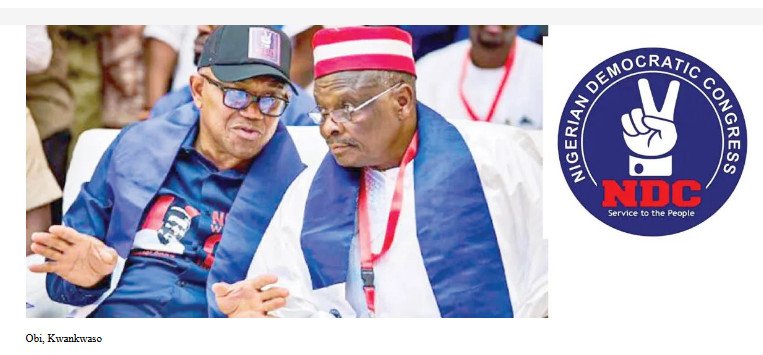
With yesterday’s judgement by a Federal High Court in Lokoja setting aside its earlier judgement directing the Independent National Electoral Commission (INEC) to register the Nigeria Democratic Congress (NDC) as a political party, uncertainty over whether the NDC would be allowed to participate in next year’s elections has increased
Newera News gathered that the court upheld the application filed by the Peace Movement Party (PMP), ruling that the party was a necessary party to the suit.
Justice Isah Dashen of the Federal High Court in Lokoja held that all relevant parties must be heard before any substantive decision can be made in the matter, as the earlier judgment was constitutionally defective as it was delivered without hearing from all interested parties.
He declared that such an omission rendered the entire process null and void.
Justice Dashen further ruled that the status quo be restored to its original posture before the December 2025 judgment pending the determination of the substantive suit.
He also observed that certain material facts were suppressed in the earlier proceedings, which justified the decision to set aside the judgment.
Consequently, the court ordered that the substantive suit should begin afresh, with INEC, the PMP and the NDC as parties to the case.
A report by the News Agency of Nigeria (NAN) said counsel to the applicant, Chikezie Ekeocha, told journalists that the PMP approached the court after discovering that NDC’s registration was based on a logo it had previously submitted to INEC before the commencement of the suit.
According to Ekeocha, the court agreed that the applicant’s rights had been affected and consequently vacated the earlier judgment.
“The court has ordered all parties to return to the position they occupied before the judgment of December 10, 2025, and directed the claimants to join all the necessary parties to ensure that the issues in dispute are effectually and completely determined,” he said.
“The recognition of the NDC, the issuance of its certificate of registration, its inclusion in INEC’s records, and any appearance on ballot papers arising from that judgement must be withdrawn pending the final determination of the substantive suit,” Ekeocha stated.
He, however, clarified that the substantive case remained before the court and had not been decided.
“The matter has not been concluded. The court merely set aside its previous judgement and directed that the party whose interests were affected be joined so that all sides could be heard before a fresh decision is reached,” he said.
Ekeocha also dismissed suggestions that the court merely ordered parties to maintain the status quo, insisting that the ruling specifically directed a restoration of the position that existed before the December 10, 2025, judgment.
NAN reports that the ruling effectively returns the dispute over registration of the NDC to the Federal High Court for a fresh hearing, with all relevant parties expected to participate before a new determination is made.
We remain registered – NDC
But in a swift reaction, the NDC rejected the verdict of the Federal High Court, insisting that it remains legally recognised and will immediately challenge the decision at the Court of Appeal.
In a statement issued on Friday and signed by Senator Moses Cleopas Zuwoghe, the national chairman of the NDC, the party noted that the court’s latest decision did not order its deregistration and therefore, does not affect its status as a registered political party.
According to the party, it approached the Federal High Court in December 2025 after INEC declined to register it, and the court upheld its constitutional right to freedom of association and ordered the electoral commission to permit the registration.
The party said that following its registration by INEC, it actively participated in the country’s political process, including membership registration, ward, local government, state and national congresses, conventions, and primary elections conducted in line with INEC’s timetable
It added that it also fielded candidates in the recent by-elections in Nasarawa and Enugu states and had already nominated candidates for the House of Assembly, House of Representatives, Senate, governorship, presidential and vice presidential elections ahead of the 2027 general elections.
The NDC argued that the Peace Movement Party is neither a registered political party nor an association currently seeking registration under INEC’s ongoing registration exercise.
It further contended that the Federal High Court had become functus officio after delivering its final judgement in the matter and had already resolved issues relating to the use of the party’s symbol and colours.
The party maintained that no appeal was filed against the December 2025 judgement and questioned the jurisdiction of the High Court to revisit its earlier decision on what it described as a mere motion.
The party said it had instructed its legal team to immediately file an appeal challenging both the jurisdiction of the court and the propriety of the latest order.
The party also accused unnamed individuals of attempting to use the judiciary to narrow Nigeria’s democratic space and suppress opposition voices.
Previous suit against the NDC
Weekend Trust recalls that the All Democratic Alliance (ADA), through Ahidjo Karlahi, had slammed a suit against the NDC, seeking its deregistration by INEC.
The suit was filed before a Federal High Court sitting in Abuja and marked FHC/ABJ/CS/1115/2026, but was assigned to Justice Mohammed Umar by the Chief Justice of the FHC, Justice Tsoho.
In the originating summons, the ADA said the NDC as a political party had not fulfilled the mandatory constitutional and statutory conditions prescribed under sections 221-225A of the Constitution of the Federal Republic of Nigeria, 1999 (as amended) and sections 75 and 79 of the Electoral Act, 2022.
INEC, however, did not respond to the matter when our correspondent reached out to them.
Our correspondent recalls that the national leader and founder of the NDC, Seriake Dickson, had declared that there was no pending litigation or appeal challenging the party’s registration during the maiden national convention of the party held at the Angeles Event Centre and Mall, Abuja.
Court ruling on NDC not a stop sign – Obi group
The presidential candidate of the Nigeria Democratic Congress (NDC), Peter Obi, has described Friday’s judgement of a Federal High Court in Lokoja, Kogi State, as a hurdle and not a stop sign. The court had mandated the Independent National Electoral Commission not to recognise the NDC as a political party pending the resolution of all surrounding legal issues.
The former Anambra State governor urged his supporters to remain calm, noting that their legal teams are currently reviewing the judgement.
This was contained in a statement issued by the Peter Obi Media Reach (POMR).
“We have received the news of today’s bizarre ruling from the court in Lokoja regarding the legal status of the Nigeria Democratic Congress. While our legal teams are thoroughly reviewing the judgement to initiate immediate corrective and appellate measures, our principal urges all supporters, coalition partners and patriots nationwide to remain absolutely calm and focused.
“We always knew that the journey to dismantle a deeply entrenched and grossly underperforming political status quo would be met with fierce institutional resistance and unexpected legal detours.
“Today’s ruling is a hurdle, not a stop sign. Our commitment to providing a transparent, legitimate and formidable alternative for Nigerians remains unshakeable. The platform we are building is robust, and our legal rights will be vigorously pursued. Do not be discouraged; the vehicle may face a temporary breakdown, but our destination remains non-negotiable.”
The party can still ask for a reversal at the appeal court – Lawyer
Reacting to the ruling, a Kano-based lawyer, Kamilu Ahmad Paki, described the decision as a clear demonstration of the court’s power to set aside its own judgement where misrepresentation or fundamental error is established.
He explained that ordinarily, once a court delivers a judgment, it becomes functus officio and such judgement can only be challenged at the Court of Appeal or Supreme Court.
However, he stressed that exceptions exist where fraud or procedural defects are discovered.
“In this case, the court found that the People’s Movement Party (PMP), which ought to have been served, was not properly brought before the court. That is a fundamental error. Once misrepresentation is established, the court is right to cancel or reverse its order,” Paki said.
The lawyer noted that the ruling relieves INEC of any obligation to register the NDC, but added that the party still has the right to challenge the reversal at the Court of Appeal.
He further observed that the case underscores the principle that while courts cannot ordinarily revisit their own judgements, they retain the authority to nullify orders tainted by fraud or misrepresentation.
‘Court rulings may strengthen APC ahead of 2027’
A political analyst, Professor Sale Dauda, has said that recent court judgements ordering the deregistration of political parties and deciding disputes involving opposition parties are unlikely to disrupt preparations for the 2027 general elections but may strengthen the ruling All Progressives Congress (APC).
Speaking on the implications of the rulings for Nigeria’s political landscape, Dauda expressed concern over what he described as the judiciary’s recent conduct, saying some of its decisions have raised questions about public confidence in the institution.
“Unfortunately, the judiciary seems not to be the last hope of the common man again,” he said.